

Well, what a day (and a half) for Happy Planet Running at the Michigan Titanium Tri. With 700 athletes doing their choice of sprint, Olympic, half, and ultra (a.k.a. “Ironman”) distances, there was an incredible amount of energy expended at and around Versluis Park in Grand Rapids. And all that effort needed recovery and refueling, resulting in lots of waste to responsibly process. I can’t say I did a triathlon, but I sure got my steps in.

Tris4Health does a tremendous job taking care of the athletes and making sure they have a good experience. Part of that is giving them a variety of post-race food and drink, and lots of it. In addition to fruit, chips, and bagels, they offered local pizza baked right there at the finish line, and Qdoba later on for the ultra distance athletes. And there was a beer tent, too. The guy running it predicted we’d fill a 96-gallon cart with the empties – and he was right.
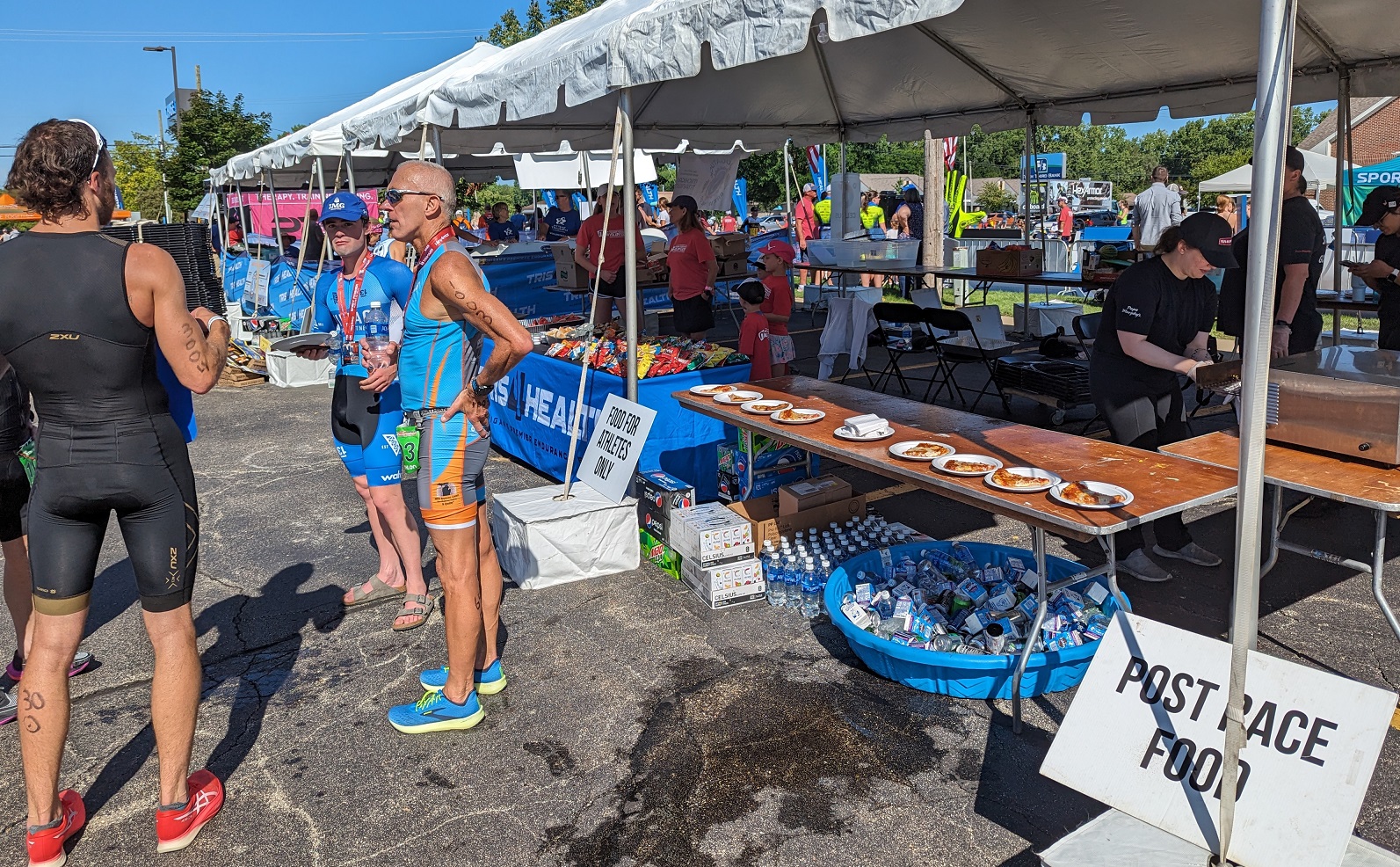
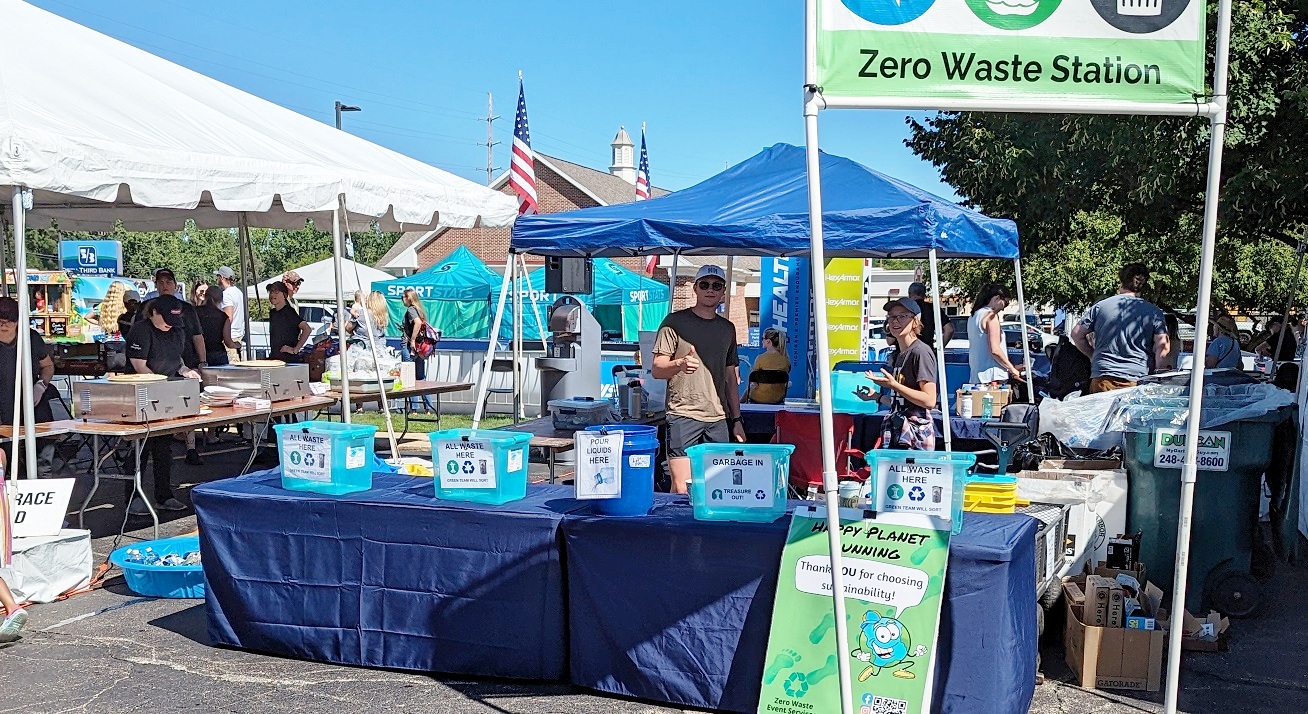
Our main station was in the finish area next to the food tent, a good location and clearly visible to the athletes. We provided All Waste boxes to the food tent, beer tent, and the coffee station farther down. Early on we added some boxes to cover athletes coming to and from the beach, removing them when the swimming section closed.
Transition was segregated by event distance – sprint, Olympic, half, and ultra – so we had waste containers on either end of each one, coming to eight total. We also put boxes at the water stations on either end of transition, and on the Run start. Checking on this setup periodically worked well until evening, when things got too busy in the finish area to properly maintain them. I think all that’s needed is an additional resource there at busy times.

Yours truly expounding on the virtues of Zero Waste with Bill, a volunteer. On the far end of our table are some of the infamous cooling towels.
I was assisted by HPR intern Kaylee in the morning through mid-afternoon, and Charlie from late morning until 10:00 p.m. Both of them cheerfully worked their tails off, and I couldn’t be happier with their effort. It turned out we were pretty severely understaffed (see below) but with their help we still ended up with a very good result.
This being such a large event, and the first year we were servicing it, there were bound to be challenges. The biggest one was my underestimating the amount of waste that would be produced. Everything we saw we’ve handled before – food waste of all kinds, snack bags, water bottles, cans, Gu wrappers, and even the cooling towels, just not in such volume. Part of that, of course, is the duration of the event, lasting from 5:00 a.m. Sunday to midnight, and on a beautiful day, people stuck around to celebrate. Below, a slideshow of a few memorable moments.

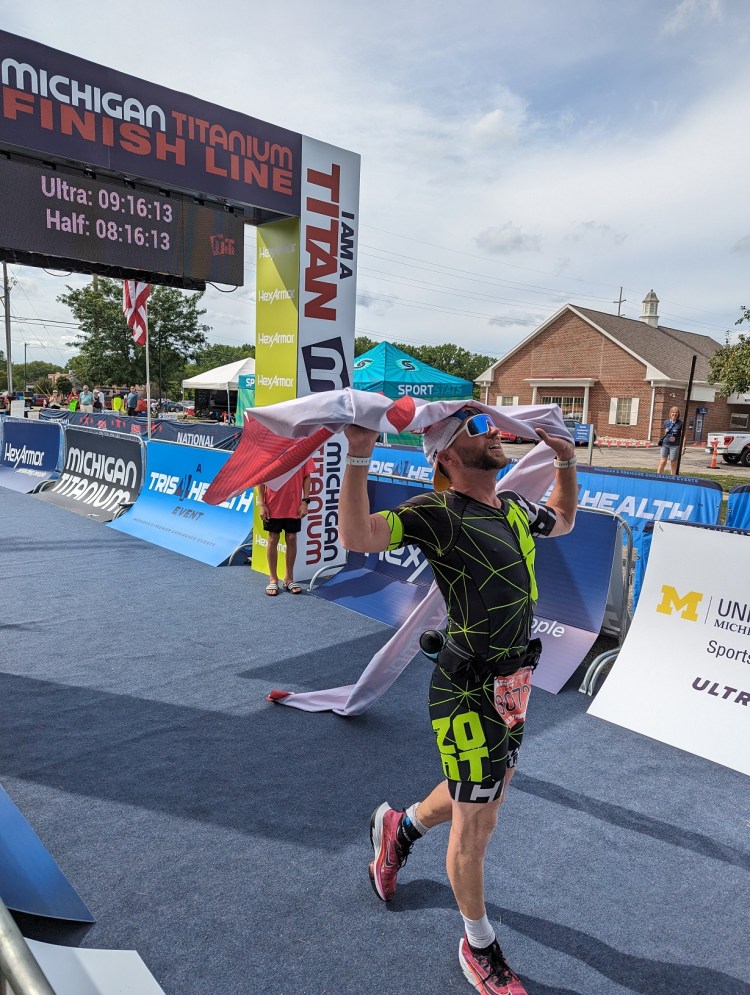

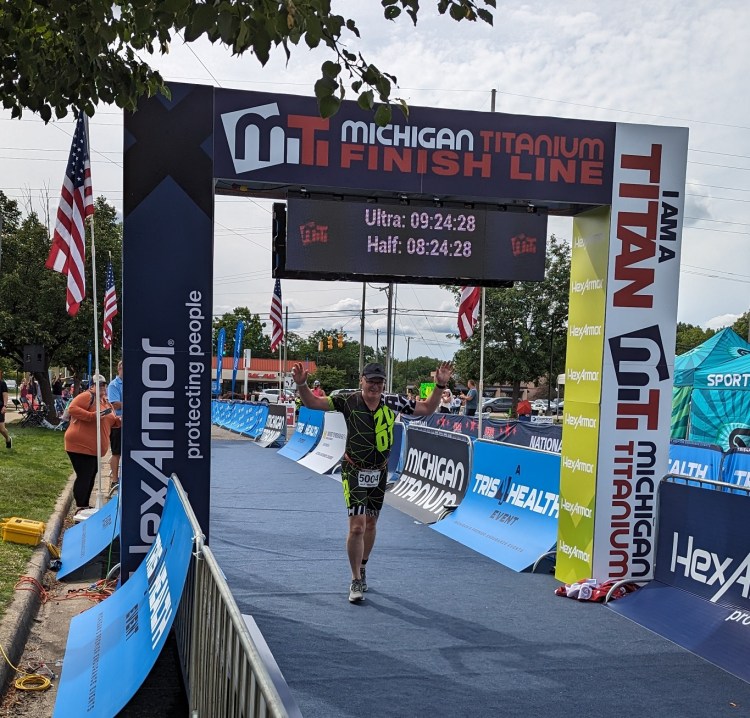


A few memorable moments.
There was also just a lot of different packaging to contend with. For example, each of the volunteer lunches (Jimmie John’s) came in a box with an individually wrapped sandwich, bag of chips, pickle in a Ziploc baggie, individually wrapped cookie in plastic, and mustard and mayonnaise packets. Each one took up valuable time to sort out properly. There were also bags from McDonald’s and other fast food places brought in by athletes and their families, which, in hindsight, weren’t worth the effort to sort.
I’d expected things to slow down after 9:00 p.m., and while the number of athletes finishing dropped off, the party kept on hot and heavy. Waste came in continuously from the food and beer tents, and even a hot dog station that hadn’t heard we were Zero Waste. (I swapped out their waxed paper plates for compostable ones.) And more aid station bags kept coming in.
Major kudos to the family of one of the race directors – Amanda Conkling and two of her sons – who’d heard Charlie and I were ‘drowning in trash’ and stepped in to help us, diving right into the aid station bags to sort them. They were a huge help and allowed Charlie and me to better stay on top of transition and the other waste generating areas.

I finally closed up shop at 1 a.m. Monday and headed back to my hotel for a few hours sleep. At 7 a.m. I dropped off the recycling at Kent County Recycling, followed by the compostables at Organicycle not far away. Then it was back to Versluis Park, where I picked up my equipment and many more bags of trash that had been collected since I’d left. Back home I sorted some of it, but with other events to prepare for the following weekend, I had to throw in the cooling towel and reluctantly send a lot of material to landfill that could have been recovered.
In the end, I filled my trailer twice with all the waste generated, which came to 1,155 lbs. by weight and around 32 cubic yards by volume. While our 82.4 percent diversion rate is lower than usual for HPR, we saved nearly a half ton of waste from going to the landfill. It’s a good start we can build on.
Just as a note, the cooling towels we collected came to about one hundred pounds! And this was after wringing them out and/or spinning them in my washing machine. They were much heavier in the bags, which no doubt added to the landfill weight for those I did not retrieve. Some will be reused at an upcoming event Kaylee is part of, and we’ll figure out a use for the rest.
The first year of any event being a learning experience, the HPR team and the folks at Tris4Health brainstormed some improvement ideas for next year. They include:
- Modify the “all waste here” model to do some pre-sorting in transition. Even a moderate degree of separating cups and Gu wrappers would save a lot of time at the station.
- Same practice at the aid stations – separate cups from non-cups. Having a separate collection bin for used cooling towels would also help a lot.
- A larger team, so we can dedicate some resources to transition and the beer tent rather than periodic visits by staff to those areas. In particular the evening shift until midnight needs adequate help to get a handle on the aid station bags while also taking care of the finish line waste coming in.
- The volunteer lunches can come with less overall packaging. Also treat all fast-food packaging as automatic landfill to save time.
Finally, many thanks to the Tris4Health staff, who, all being equally busy, supported us however they could. The volunteer coordinators even lent me a notebook for collecting data when I’d left mine at home. And thanks also to the athletes who took the time to appreciate us, proving it’s really not a thankless job after all!

 Happy Planet Running