

Hey, did you know ultrarunners eat a lot?
Actually, if you’re an ultrarunner, know one, or even live with one (God bless you), you’re already quite aware of that. And it makes perfect sense. Running 100 miles burns about 10,000 calories more or less, depending on your body type and effort level. That’s 3.5 pounds of actual mass, not water weight loss. Consistent fueling is key to sustaining a strong effort that long.
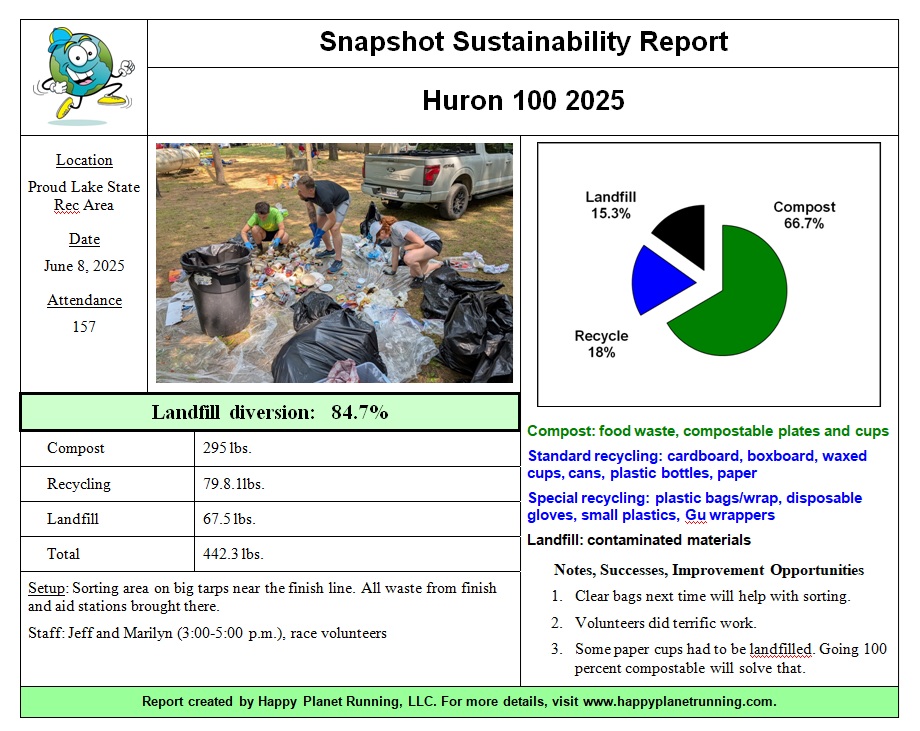
So it’s not at all surprising the vast majority of waste generated by last Sunday’s Huron 100 was food-related, as the chart below shows. And with the majority of Michigan’s food waste still going to landfill and creating greenhouse gases, every little bit we can turn back into good clean dirt helps. So Happy Planet Running was happy to accept the request from the race organizers to help make their event more sustainable.
The Huron 100 is a new (2nd official year) ultra that starts in the Gregory area, goes along trails through several recreation areas, and ends at Proud Lake. Along the way are 14 aid stations, each offering the participants a variety of food and drink to keep them moving merrily along.
We agreed to help them at the finish line near the close of the event and do as much sorting as practically possible. Then we would take away and process the compostables, recycling, and specialty items (including what turned out to be over 10 lbs. of Gu wrappers alone). They also designed the race to be as “cupless” as possible, although some had to be used for hot foods and other needs.
Intern Marilyn and I (Jeff) arrived at Proud Lake around 3:00 to find a volunteer team already hard at work on the waste! They’d already created several bags of sorted compostables and a large bag of recycling, as well as some bags of landfill. Marilyn joined in sorting the remaining bags while I checked the compost bags and removed some items that didn’t belong in there, then went through the landfill bags and retrieved some items we could actually recover. I also set up pails and boxes for theTerraCycle items and focused my effort mainly on retrieving and collecting them.
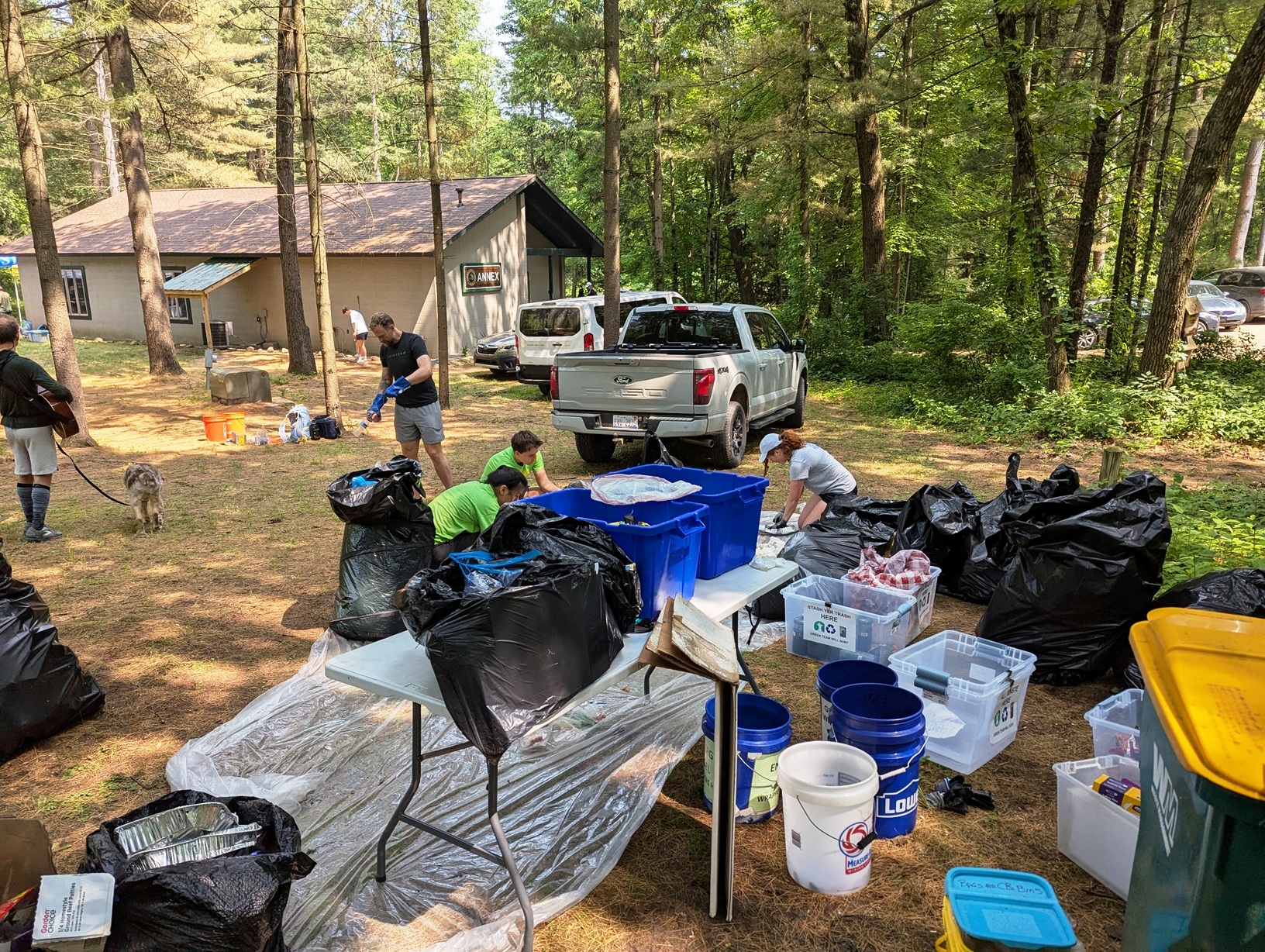
A view of the sorting area, with the various collection boxes and pails. Sorted bags on the right. On the left is a guy serenading us with his guitar. (“Working on our trash moves…”)
Here’s a summary of what we processed.
Compost: food waste (including lots of watermelon rinds), napkins, compostable cups and plates, paper towels. Volume-wise, it was about 1.5 cubic yards!
Recycling:
- Cardboard and clean paper
- Recyclable cups (waxed and not contaminated)
- Clean plastic bags and plastic wrap
- Metal: propane tanks, Sterno cans, aluminum trays that held food
- Specialty items: Gu and snack bag wrappers, race bibs, small plastics, party decorations (e.g. glow sticks), and table covers
Landfill: tape, contaminated items, wet wipes, and other items we couldn’t process.
We managed to capture nearly 85 percent of the total waste, a terrific result for a first-year effort. Here are some suggestions for doing even better next time:
- Go completely compostable with cups, plates, and utensils
- Reduce use of wet wipes if possible, which must be landfilled, and it’s difficult to distinguish between them and paper towels, which can be composted
- Use clear bags instead of black ones, which will help identify how badly mixed a bag is and easily identify what can be recovered from it
- If possible, keep plastic bags out of trash bags that contain food.
Congratulations to all the runners, especially the finishers, and to the Huron 100 race team for doing their best to make their event sustainable!
 Happy Planet Running